The IMO’s new GHG Fuel Intensity (GFI) framework will penalize fossil-fueled LNG ships, costing owners millions. We have modeled the solution. Our proprietary TCD Technology achieves an 81% Well-to-Tank (WtT) emission reduction, translating to US$210/ton in avoided penalties and compliance guaranteed until 2037.
Stop paying fines, start planning for Net-Zero!
The Regulatory Crossroads for LNG
The Compliance Clock is Ticking: Why LNG Ships Face Penalties Despite Being the ‘Best’ Fuel Today
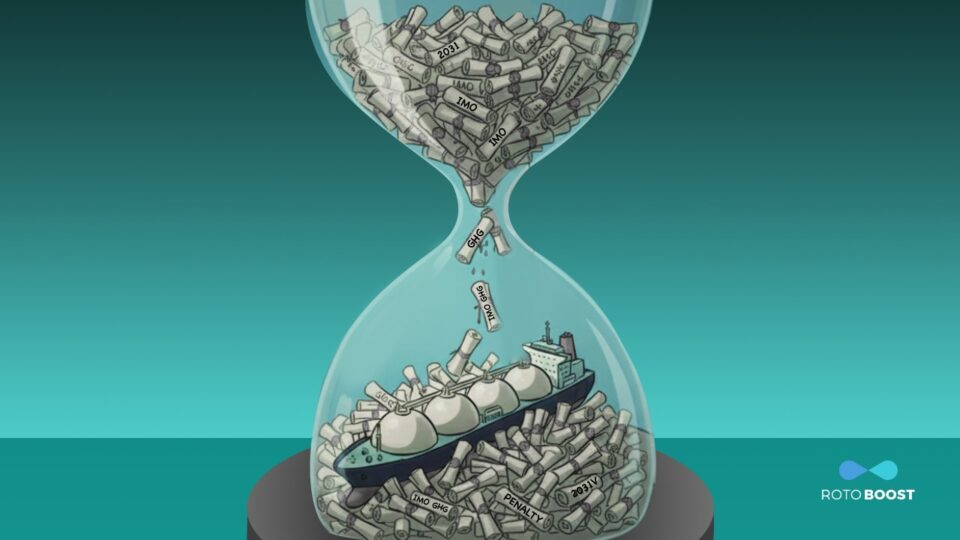
Although LNG is currently considered the most environmentally friendly available fuel, LNG ships will soon incur significant penalties under the IMO’s GHG Fuel Intensity framework. The existing proposal indicates that every LNG ship operating solely on fossil fuel will be penalized for non-compliance by 2031—likely sooner—due to methane slip. IMO regulators are no longer ignoring the unburned methane escaping into the atmosphere. The result? A penalty structure that turns fuel efficiency savings into regulatory fines. Methane is a potent greenhouse gas and high methane slip is not only an environmental concern but it is also an urgent capital expenditure and compliance threat for the shipowners.
To cap it all, for the shipowners this could mean:
- LNG ships operating solely on fossil fuel will likely face non-compliance penalties by 2031.
- Due to the severity of methane slip, penalties may arrive even sooner than projected.
- This isn’t just an environmental report issue; it is an urgent capital expenditure threat.
In the urgent fight against climate change, one would assume all emission mitigation efforts are welcomed. Yet current regulations often dismiss these efforts when they originate from fossil pathways. For instance, rules state that actual Well-to-Tank (WtT) emission factors do not apply to purely fossil pathways. This approach is not technology neutral and hinders climate mitigation within the fossil fuel industry. Can our planet afford to neglect viable reductions simply because they come from fossil fuels?
The High Cost of Non-Compliance
Counting the Cost: Financial Implications for Shipowners Under the IMO GFI Framework
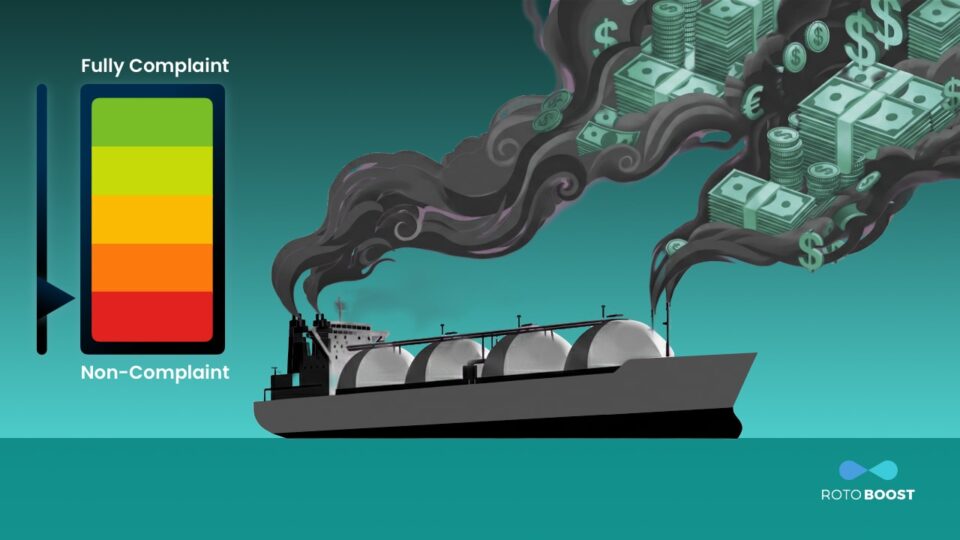
While updating the regulatory WtT value for LNG to reflect industry improvements is necessary, such a revision would delay a ship’s non-compliance by only one year, to 2032. This brief extension is unlikely to sway investment decisions in favor of LNG. However, for an LNG shipowner, updating the WtT value to reflect current data would yield savings of US$23/ton of LNG bunkered before the Tier 2 compliance limit is reached. After exceeding the Tier 2 limit, the savings increase to US$87/ton. Such a permanent reduction in WtT emissions in a situation where the cost of non-compliance is inevitably rising year by year, would provide long term benefit for the shipowner and recognize the role of LNG as a transition fuel. However, for LNG to remain the most affordable low carbon fuel beyond 2035, the entire value chain requires a radical decarbonization solution.
The Decarbonization Power of TCD Technology A System-Level Solution
How TCD Decarbonizes Upstream and Midstream LNG Processes
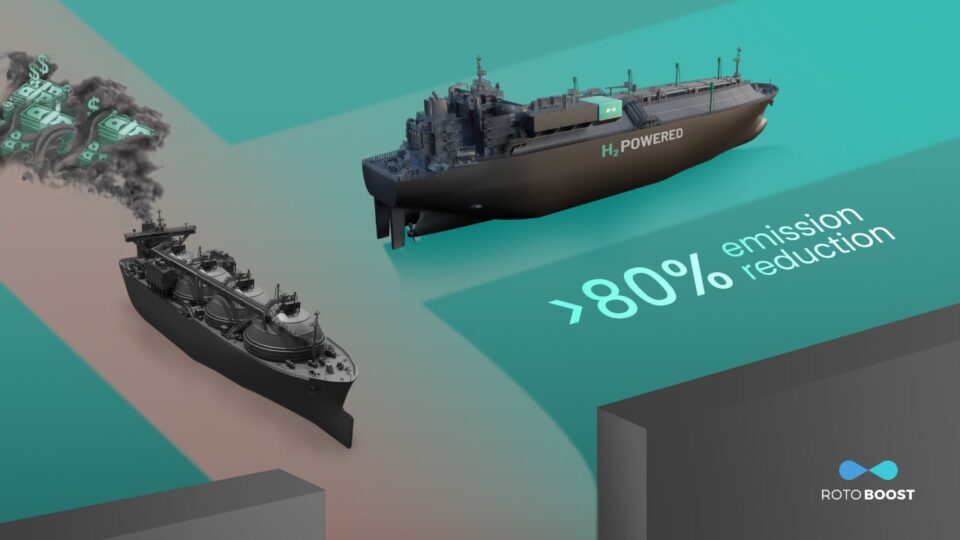
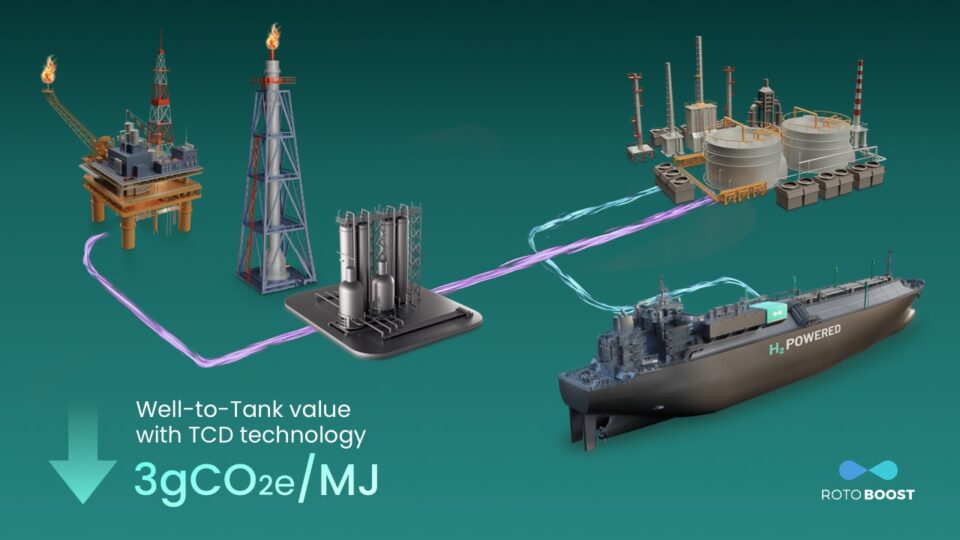
Our TCD technology can decarbonize numerous upstream and midstream processes in the LNG value chain. It can achieve nearly a 50% reduction in Tank-to-Wake (TtW) emissions from combustion and further reduce emissions by mitigating methane slip in flaring. With full integration of TCD across the upstream and midstream, we estimate a total WtT emission reduction potential of 60%. Incorporating pressure swing adsorption for the TCD decomposition gas could push this reduction beyond 80%. A detailed breakdown will be presented in our paper at the ‘21st International Conference & Exhibition on Liquefied Natural Gas (LNG2026)’ in Doha, Qatar.
Achieving Compliance and Delivering Savings
From Penalty to Profit: Quantifying Owner Savings with a Fully Decarbonized LNG Value Chain
An 81% reduction in WtT emissions—achievable with our TCD applied across the value chain—would allow LNG ships to meet direct IMO GFI compliance levels until 2034 and the base target until 2037. For shipowners, this translates to savings of US$210/ton of LNG in avoided non-compliance costs, compared to using current emission benchmarks, provided TCD is applied across the value chain.
The Vision for a True Transition Fuel
Beyond 2035: Pushing LNG Toward Negative Emissions and a Merged Bio-Fossil Future
Our research estimates that with the help of TCD technology, the LNG value chain can lower its WtT value below 3gCO₂e/MJ, allowing LNG to fulfill its promise as a true transition fuel. Achieving a negative WtT value and a Well-to-Wake (WtW) value below 55gCO₂/MJ would require carbon capture to produce e-LNG or to capture post combustion emissions. Both options are complex and costly.
A Call for Neutrality: Why We Need Regulations That Welcome Every Mitigation Effort
To limit global warming in line with the Paris Agreement, we need technology neutral regulations that encourage every possible contribution. Deploying TCD technology within fossil based upstream and midstream value chains is key to making LNG a genuine transition fuel. Furthermore, combining TCD with biomethane streams can remove atmospheric carbon, beginning the essential cleanup of excess CO₂.
We cannot afford to exclude any climate mitigation efforts. Instead, we must seek solutions that merge the best of both bio and fossil worlds. To maximize the global impact, we need to focus our mitigation efforts on the major emission sources – decarbonizing the fossil fuels. This does not mean the end for LNG—it means the advent of decarbonized LNG with the help of ROTOBOOST TCD technology across the LNG value chain.
What’s next? Secure your compliance roadmap!
If your organization wants to avoid impending GFI penalties, achieve compliance, and have a profitable future for your LNG fleet, get in touch with us so that we can discuss the potentials of how our TCD technology and we can provide you with a technical feasibility plan.
E-mail us at: info@rotoboost.com